Context
Napoleon truly expressed the thought prior to his death in 1821, albeit in different words. The earliest record of the quote in English, published in 1836, read, "When the enemy is making a false movement, we must take good care not to interrupt him." A French-language version of the same quote first appeared in 1827.

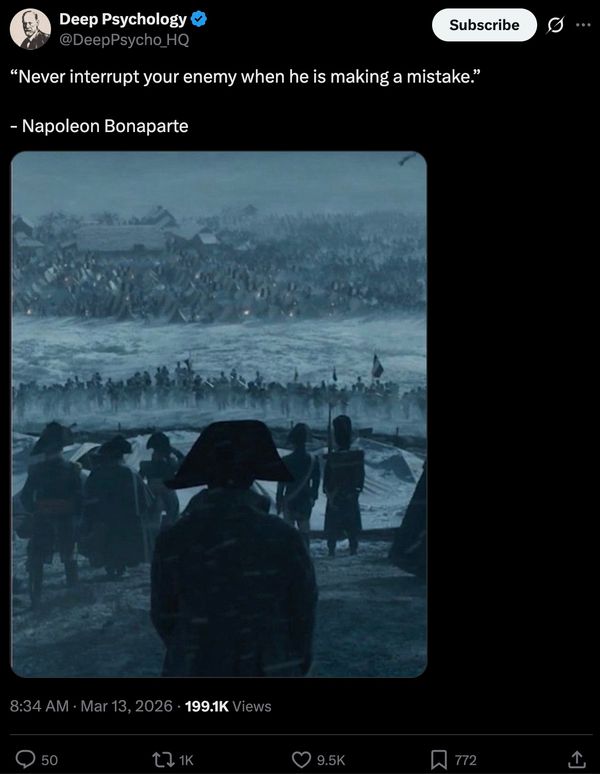
In March 2026, social media users shared an alleged quote by Napoleon, claiming the French general and emperor once said, "Never interrupt your enemy when he is making a mistake."
For example, on March 13, an X user posted (archived), "'Never interrupt your enemy when he is making a mistake.' - Napoleon Bonaparte." Other users shared the quote with Napoleon's name on Bluesky (archived), Facebook, Instagram (archived), LinkedIn (archived), Threads (archived), TikTok (archived) and X (archived).
In short, Napoleon truly expressed the thought prior to his death in 1821, albeit in different words. The earliest record of the quote in English read, "When the enemy is making a false movement, we must take good care not to interrupt him." The French-language version, documented earlier, read, "Quand l'ennemi fait un faux mouvement, il faut se garder de l'interrompre."
Users circulated the purported Napoleon quote in early 2026 after the U.S. and Israel started a war with Iran on Feb. 28. Weeks later, in late March, "Reacher" actor Alan Ritchson posted (archived) the quote with Napoleon's name in a meme after his widely reported physical fight with a neighbor.
Researching the Napoleon quote
A search of Google Books, the Internet Archive, Newspapers.com and the Quote Investigator website located the earliest versions of the Napoleon quote.
Instead of "Never interrupt your enemy when he is making a mistake," Scottish historian Archibald Alison's 1836 French Revolution book quoted Napoleon as saying, "When the enemy is making a false movement, we must take good care not to interrupt him." The quote appears on Page 476 in Chapter XL, "Campaign of Austerlitz," spanning September through December 1805 (emphasis ours):
The marshals who surrounded Napoleon saw the advantage, and eagerly besought him to give the signal for action; but he restrained their ardour, and turning to Soult, said, "How long would it take you from hence to reach the heights of Pratzen?" — "Less than twenty minutes," replied the Marshal; "for my troops are in the bottom of the valley, covered with mist and the smoke of their bivouacs; the enemy cannot see them." — "In that case," said Napoleon, "let us wait twenty minutes; when the enemy is making a false movement we must take good care not to interrupt him." Burning with impatience, the marshals stood around awaiting the signal; but before that time was fully elapsed, a violent fire was heard on the right, towards Tilnitz, and an aide-de-camp arriving in haste, announced that the enemy had commenced the attack in great force in that quarter. "Now, then, is the moment," said Napoleon; and the marshals set off at the gallop in all directions for their respective corps. At the same time the Emperor mounted his horse, and riding through the foremost ranks, "Soldiers," said he, "the enemy has imprudently exposed himself to your blows; we shall finish the war with a clap of thunder."
Alison cited a source with the abbreviated text "Jom." for Baron Antoine-Henri Jomini's French-language 1827 book, "Vie Politique Et Militaire De Napoléon." Jomini documented the quote on Page 180 as, "Quand l'ennemi fait un faux mouvement, il faut se garder de l'interrompre."
Napoleon's quote in the 1964 US elections
Garson O'Toole (a pseudonym), writing for the credible Quote Investigator website, researched a previous iteration of the Napoleon quote in 2010 reading, "Never interfere with an enemy while he's in the process of destroying himself."
O'Toole traced the history of the quote's variations, including crediting historian Theodore H. White with possibly further popularizing the quote — at least in the world of politics — in the 1965 book "The Making of the President 1964." The quote appears in the latter half of the work (emphasis ours):
With facilities and staff like these, the formal campaign of 1964 proceeded almost flawlessly. The offensive against Goldwater rolled almost by itself—the nightly radio and television news spots; the organizational and creative deviltry of the Five O'Clock Club; the independent counter-offensive of Hubert Humphrey—all these held Goldwater in torment on the issues of bomb and Social Security, while the President was free to spread balm and peace and friendship and promises all around the nation. Never were Republicans denounced as such; the opposition was involved in its own civil war, and the President obeyed Napoleon's maxim: Never interfere with the enemy when he is in the process of destroying himself.
For further reading, we previously investigated whether novelist George Orwell once wrote, "People sleep peaceably in their beds at night only because rough men stand ready to do violence on their behalf."